The Challenge
As Oman advances its Vision 2040 agenda, Sultan Haitham City is planned as a new, sustainable urban district on the western edge of Muscat. The city is designed not only to house residents, but to provide the proactive social infrastructure that makes communities work: schools, health facilities, parks and mobility networks.
Within this context, the Ministry of Housing and Urban Planning (MoHUP) needed a new generation of public schools that could do more than deliver traditional classroom teaching. The brief called for facilities that support modern, collaborative education, operate efficiently in a warm climate, and serve as active community hubs for surrounding neighborhoods.
Engicon's assignment focused on the school component of the city, including designing multiple school clusters and a rehabilitation centre that would anchor several neighborhoods and set a benchmark for future educational projects in Oman.
The Solution: Learning by Design
Engicon is taking an active role in advancing Oman’s Vision 2040 through the Sultan Haitham City: Public Schools Project, commissioned by MoHUP. Working as a sub-consultant to Ibn Khaldun Al Madaen Engineering Consultancy (IKAM). Engicon’s engineers are responsible for the detailed design and tendering of an innovative architectural concept developed by Köhler Architekten + beratende Ingenieure GmbH.
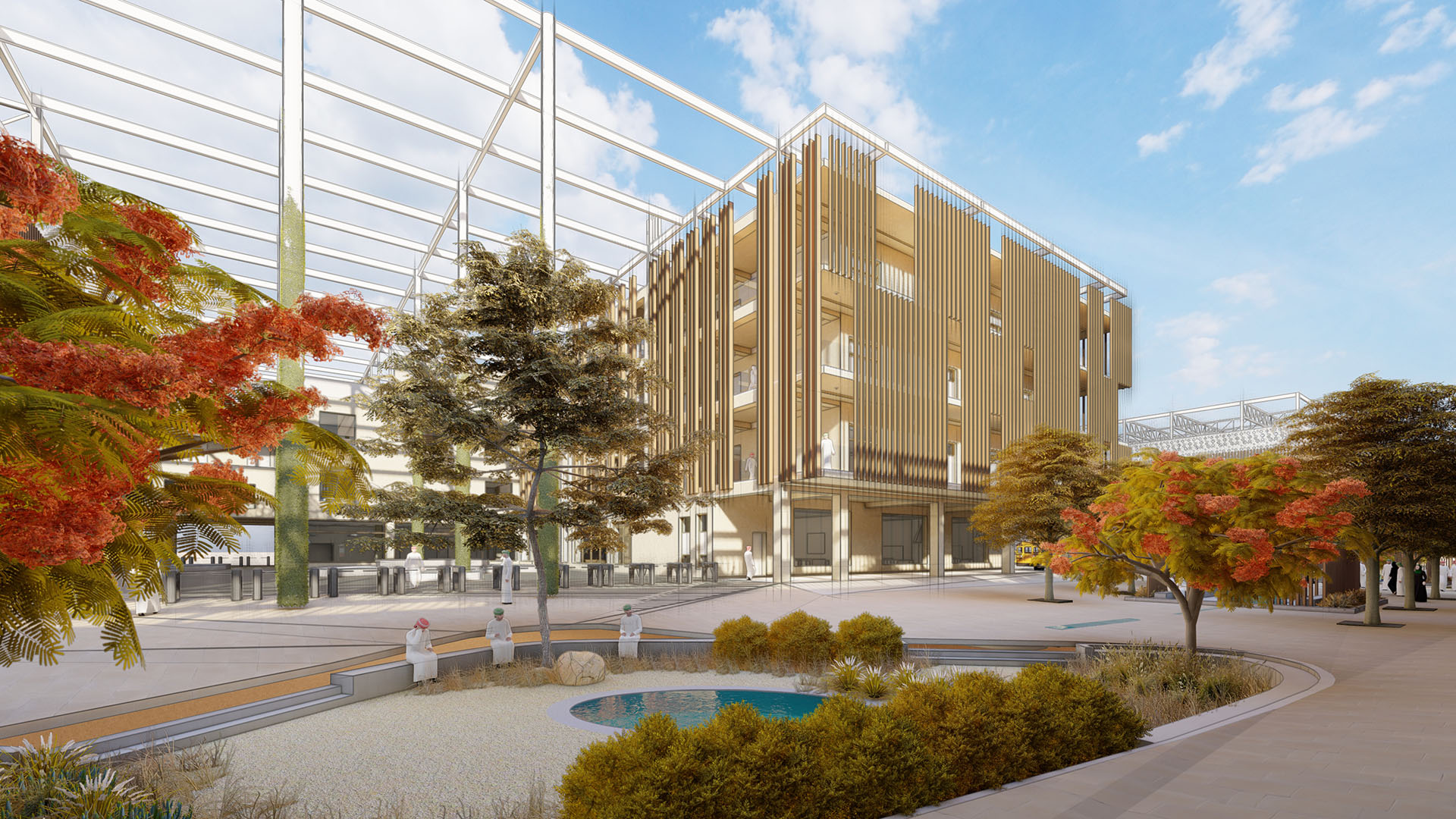
At the heart of the project is the Munich Learning House concept, which organizes classrooms and shared spaces into flexible, human-scale clusters. The schools are conceived as vibrant community hubs, with learning spaces, workshops, cafés and sports fields arranged to support both school-day use and wider community life.
We approached the Sultan Haitham City Public Schools as a multi-school orchestration problem. Engicon’s multi-disciplinary team focused on three critical tensions:
One: Flexible Learning Without Losing Structure
Contemporary education in Oman is moving toward project-based and collaborative learning. Schools, however, still require clear organization, supervision and safety.
The planning approach uses the Learning House model to:
- Group classrooms around shared commons for group work and informal study
- Provide breakout spaces for small-group teaching and individual support
-
Allow layouts to be reconfigured as the curricula, technology and teaching methods evolve
Architectural elements such as wrap-around balconies, shaded terraces and rooftop gardens, to extend learning into outdoor areas. Semi-covered central playgrounds are positioned near key facilities, giving each school cores that can adapt to assemblies, recreation and community events.
Two: Schools as Neighborhood Community Hubs
Sultan Haitham City’s schools are designed to serve not only students, but to engage with the wider community.
The school layouts:
- Position workshops, multi-use sports fields and selected internal spaces for controlled community access outside school hours
- Integrate cafés and social areas that can be used for parent meetings, events and neighborhood activities
- Maintain clear separation between public, semi-public and learning-focused zones to preserve safety and security
Following this approach, each campus doubles as a neighborhood anchor, supporting social cohesion and maximizing the public value of educational investment.
Three: Safe, Connected and Sustainable Campuses
A new city demands infrastructure that is safe, efficient and future-ready.
Engicon’s designs incorporate:
- A well-planned traffic concept that separates pedestrian, cycle and vehicle routes for safe access and drop-off
- Structural and MEP systems sized for high-occupancy teaching spaces, laboratories and sports facilities, with capacity for future technology upgrades
- Environmental and social impact considerations, including shading, natural ventilation strategies and landscape design that responds to local climate
The result is a set of school clusters that fit seamlessly into Sultan Haitham City’s mobility network and public realm, while reducing operational burdens over the life of the buildings.
Engineering the Details
Building on the competition-winning concept, Engicon provides a full range of services in educational infrastructure, including:
- Educational spatial planning and site planning
- Environmental and social impact assessments (ESIAs)
- Structural and MEP (mechanical, electrical and plumbing) design
- Environmental and traffic impact assessments
- Interior design and landscape design
- Sustainability consulting and green building strategies
- Facility manuals and management guidelines to support long-term operation and maintenance
This multidisciplinary role ensures that the architectural vision remains intact while meeting Omani standards, budget constraints, and construction feasibility requirements.
More Than Just Schools
For Oman, the Sultan Haitham City Public Schools Project is a pivotal building block of Vision 2040:
- For students: flexible, inclusive learning environments that support modern teaching and holistic development
- For families and communities: accessible community hubs with shared facilities that strengthen neighborhood life
- For the Ministry and education authorities: a replicable model for future schools that aligns with national urban and educational strategies
- For Engicon: a demonstration of how international educational concepts can be translated into resilient, regionally appropriate designs for a new city
Engicon remains dedicated to creating innovative, inclusive and sustainable educational environments that benefit students and the wider community across Oman and beyond.